
Global private equity investor Advent International on Monday said it is acquiring a significant stake in Suven Pharmaceuticals from its promoters, the Jasti family. The PE major said this will be followed with an open offer to acquire 26 per cent more in the listed contract development and manufacturing organisation from public shareholders, and also merge the company with investee company Cohance Lifesciences, as per an official statement. Media reports on a Monday morning pegged the acquisition at Rs 6,300 crore, and that Advent had pipped rival Blackstone for the acquisition.

Relief Commissioner Alok Pandey told reporters that the government is constantly working to ensure that there is no loss of life due to the weather phenomenon.
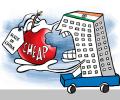
A decline in demand from six of India's top 10 import partners -- China, Saudi Arabia, Iraq, South Korea, Australia, and Singapore -- resulted in India's imports hitting a 17-month low of $50.6 billion in January, showed the data compiled by the department of commerce. Shipments from South Korea, Australia, and Singapore declined by 14.1 per cent, 26.7 per cent, and 9.8 per cent, respectively. Among the 10, growth in inbound shipment was seen only in the case of the United Arab Emirates (12.1 per cent), the US (27.4 per cent), Russia (297.4 per cent), and Indonesia (22.9 per cent).

Notwithstanding the inflation pinch, analysts believe the Indian retail sector is on the 'cusp of accelerated earnings growth' as consumer sentiment and discretionary purchases bounce back from the Covid-19 pandemic. "The shift in consumer preference from the unorganised sector to the organised, coupled with uptick in domestic demand as people resume work from office, will cheer the Indian retail sector," says Nishit Master, portfolio manager, Axis Securities. Shopping malls are witnessing increased footfall in lower tier towns and standalone stores as consumption picks up and mobility improves.

'IIM Ahmedabad has seen one of the best placement seasons ever and this change can be attributed to the markets opening up after the pandemic.'

Private equity investments into domestic companies fell sharply year-on-year by 42 per cent to $23.3 billion in 2022, which is the lowest since 2019, when it was $15.8 billion, according to an industry report. The numbers reflect the overall funding winter that the startup space in particular, and the overall foreign investments in general have been witnessing since the Ukraine war began last February. Private equity investment inflows into the country fell by a sharp 42 per cent in 2022 from last year to $23.3 billion -- the lowest annual inflows since 2019 when it was a low $15.8 billion, but still relatively elevated compared to historical levels, said Elaine Tan, a senior analyst at Refinitiv, the LSEG business arm that provides financial markets data and insights.

After the Covid-19 pandemic that derailed the economy since 2019, the Durga Puja festival in West Bengal is back with an estimated 20-30 per cent jump in festive spending. Retail sector is the key contributor to the state's Durga Puja economy which was Rs 32,377 crore in 2019, according to a British Council study conducted for the state government. Retail accounts for 85 per cent of the total puja economy and the rest is shared among pandal making, decoration, illumination, entertainment, advertisement, food & beverage and others.

Infrastructure investments in politically-expedient sectors such as water supply, sanitation and irrigation have seen an increase during the first year of the 12th Five-Year Plan (2012-13 to 2016-17), but the same did not get replicated in other critical sectors.

IndusInd Bank was the top loser, shedding nearly 4 per cent, followed by Bajaj Finserv, Bharti Airtel, TCS, HCL Tech and Tech Mahindra.

From a location perspective, the last quarter saw Kolkata and Gurgaon as top regions for employment in these sectors and among roles, sales and office services stood out.

The Indian high commission in London on Friday appealed for students to contact the mission for help and counselling amid fears that over 50 of them may have become victims of modern slavery while working at care homes in North Wales.
.jpg)
Barring one, three are debt-free and sitting on large cash reserves.

In twin blows to Indian economic revival, higher food prices drove retail inflation to a five-month high of 7.4 per cent while factory output fell for the first time in 18 months. The second consecutive month of rise in consumer price index (CPI)-based inflation will add to the pressure on the Reserve Bank of India (RBI) to again raise interest rates to tame high prices. Inflation has been above the targeted zone for the ninth month in a row and as per statute, the RBI will now have to explain to the government in writing why it failed to keep prices below 6 per cent.

On Sunday, August 28, a series of controlled explosions reduced the 100-metre tall Supertech twin towers structures in Noida to a huge pile of rubble.

'The actions of Indian monetary authorities will depend on how quickly they want the inflation to come down to 4 per cent.'
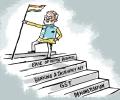
India's GDP expanded 13.5 per cent in the April-June quarter, the quickest pace in a year, to retain the world's fastest growing economy tag but rising interest costs and the looming threat of a recession in major world economies could slow the momentum in the coming quarters.

Fuelled by the $57.8-billion merger of HDFC twins (HDFC Ltd and HDFC Bank), M&A (merger and acquisition) transactions in India touched a record high of $124.2 billion in the first half of 2022-23. Bankers said with several transactions, including the government's stake sale in IDBI Bank and Hindustan Zinc in the pipeline, the ongoing financial year will end up as the best year for M&A activity in the country. Apart from the HDFC transaction, the $6.5-billion acquisition of Holcim stake by the Adani family and L&T's $3.2-billion acquisition of Mindtree added to the record transactions in the first half of FY23.

Collectively, the pack of 12 has posted a 50 per cent rise in profits -- Rs 25,685 crore. On a quarter-on-quarter basis (that is, September over June), the rise is 68 per cent. Public sector banks have never had such a stellar performance, explains Tamal Bandyopadhyay.

Debt-ridden telecom operator Vodafone Idea on Tuesday approved the allotment of equity shares worth Rs 16,133 crore to the government, which post-allocation has become the largest shareholder with a 33.44 per cent stake in the company. The shares have been allocated to the government in lieu of conversion of interest dues arising from deferment of adjusted gross revenue and spectrum auction payments, the company said in a regulatory filing. "...it is hereby informed that the board of directors of the company has, at its meeting held today approved the allotment of 16,133,198,899 equity shares of face value of Rs 10 each at an issue price of Rs 10 per equity share aggregating to Rs 161,331,848,990 to the Department of Investment and Public Asset Management, Government of India," the filing said.

After a hiatus of nearly two decades, the government's programme to privatise state-owned firms restarted with the handing over of debt-laden national carrier Air India to the Tata Group. With the new owner shelling out Rs 18,000 crore for the buyout of the 'Maharaja', this would be the highest-ever amount garnered through privatisation, and is even more than the cumulative sum mopped up through strategic sales from 1999-00 to 2003-04. The government had in October last year inked the share purchase agreement with the Tata Group for sale of national carrier Air India for Rs 18,000 crore. Tatas would pay Rs 2,700 crore cash and take over Rs 15,300 crore of the airline's debt.
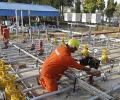
Lowering excise duty on petrol, diesel, and other fuels, branded fuels.

India must integrate more with East Asia by getting into regional trade arrangements, lower its tariff walls, and improve the quality of its workforce, suggests T N Ninan.

Chief economist at State Bank of India has revised downward the full-year growth forecast to a low 6.8 per cent from 7.5 per cent earlier for FY2023, citing "the way below GDP numbers for the first quarter". The National Statistical Office on Wednesday released the Q1 growth numbers which showed a consensus growth of 13.5 per cent, pulled down by the poor show of the manufacturing sector, which reported a paltry 4.8 per cent expansion in the first three months of FY23, negating the robust show by the services sector. Consensus forecast was 15-16.7 per cent of which the RBI made the highest forecast of 16.7 per cent.

India's economic growth surged to 20.1 per cent in the April-June quarter of this fiscal, helped by a low base of the year-ago period, despite a devastating second wave of COVID-19. The gross domestic product (GDP) had contracted by 24.4 per cent in the corresponding April-June quarter of 2020-21, according to data released by the National Statistical Office (NSO) on Tuesday. The government had imposed a nationwide lockdown at the onset of the COVID-19 pandemic last year.

The job market saw an uptrend in the March quarter (Q1), with job interviews increasing 13.71 per cent quarter-on-quarter (QoQ) to over 30 million, according to Apna.co, India's largest jobs and professional networking platform. It recorded a 42 per cent QoQ growth in its employer base. As a result of the second wave of Covid-19 last year, sectors such as healthcare, delivery, and e-commerce were booming while others had fairly low employment.

The Chinese activity at an air base near the Barahoti area has also gone up and a large number of drones have been deployed by them there, they said.

With the new owner shelling out Rs 18,000 crore for the buyout of 'Maharaja' this would be the highest ever amount garnered through privatisation or even the cumulative sum garnered through strategic sale in 1999-00 to 2003-04. The government had garnered roughly over Rs 5,000 crore during that five-year period by privatising 10 CPSEs.

Whether this remains under control in the coming months will depend on the future intensity and spread of the Russia-Ukraine war, and the effectiveness of the Indian government's response, points out A K Bhattacharya.

Be it roads, railways, ports, civil aviation, energy or electricity, the Narendra Modi govt has invigorated all these sectors since it took over, says Arvind Panagariya.

Amid the low stock position at the electricity generating plants, state-owned CIL has asked its subsidiaries to refrain from conducting any further e-auction of coal, except special forward e-auction for the power sector, till the situation stabilises. The development assumes significance as the supply of coal is being prioritised to the power sector to replenish the dwindling stock in the wake of reports of an electricity crisis looming large. "In view of the current low stock position at the powerhouse end, supply of coal is being prioritised to the power sector to replenish the dwindling stock...coal companies are advised to refrain from conducting of any further e-auctions of coal with the exception of special forward e-auction for the power sector, till the situation stabilises," Coal India said in a recent letter to its arms, including Eastern Coalfields Ltd (ECL), Bharat Coking Coal Ltd (BCCL), Central Coalfields Ltd (CCL).

The Indian economy recovered from the Covid-induced downturn during 2022 and is poised for further improvement in the coming quarters though downside risks emanating from geopolitical tensions, strengthening dollar and elevated inflation will continue. The positive trajectory in the growth trend and improved fundamentals will help the nation in neutralising the impact of global headwinds which are expected to have a bearing on the country's exports in the months to come. The challenges before the government and the Reserve Bank in the new year would be to arrest inflation, check declining value of rupee against US dollar and promote private investment and growth, with a view to ensure that the country remains one the fastest growing major economies of the world.

The Sensex opened below the 5,300-mark with a loss of 30 points at 5,296.

Donations from corporates to the national parties increased by 109 per cent between FY 2017-18 and 2018-19, said an analysis by the Association for Democratic Reforms (ADR), an NGO working for bringing in transparency in electoral politics.

India's exports are unlikely to get an immediate boost from a depreciating rupee, which touched an all-time low on Monday, driven by rising commodity prices. The rupee fell to 76.97 against the dollar earlier in the day, settling 1.05 per cent weaker than the previous close. Oil prices soared to their highest since 2008 on Monday at $139 per barrel, after the US and European allies explored a Russian oil import ban, while delays in the potential return of Iranian crude oil to global markets increased supply fears.
Axis Bank on Thursday reported a 54 per cent jump in its standalone net profit to Rs 4,117.77 crore for the quarter ended March 2022. The country's third-largest private sector lender had posted a net profit of Rs 2,677.06 crore in the year-ago period. The total income (standalone) rose to Rs 21,999.58 crore in the January-March period of 2021-22 against Rs 19,035.12 crore in the same period of 2020-21, Axis Bank said in a regulatory filing. For the full 2021-22, the net profit nearly doubled to Rs 13,025.48 crore from Rs 6,588.50 crore in 2020-21.

India Inc is set to post an 18-20 per cent revenue growth for July-September as compared to the year-ago period, domestic rating agency Crisil said on Thursday ahead of the filing of quarterly earnings by companies. The handsome growth in the topline will be driven by both higher volumes and higher commodity prices, the rating agency said. However, the rising input prices may have capped operating profit margin expansion for companies when compared to the preceding quarter, the agency said.

Banking and financial stocks got more than their fair share of foreign portfolio investor (FPI) flows in February. Overseas investors pumped in $3.56 billion into domestic equities last month. Of this $1.96 billion went into financial stocks, data analysed by Edelweiss shows. "The sector now has 34.8 per cent of FPI assets, up from 33.8 per cent in January.

India's economic growth slowed to 8.4 per cent in the second quarter of 2021-22, mainly due to waning low base effect, official data showed on Tuesday. The GDP growth in April-June quarter this fiscal stood at 20.1 per cent. The Indian economy had contracted by 24.4 per cent in April-June last year.

Industrial production grew 11.9 per cent in August mainly due to a low-base effect and good performance by manufacturing, mining and power sectors that surpassed the pre-COVID level. The manufacturing sector, which constitutes 77.63 per cent of the Index of Industrial Production (IIP), grew 9.7 per cent in August, according to the data released by the National Statistical Office (NSO) on Tuesday. The mining sector output rose 23.6 per cent in August, while power generation increased 16 per cent.

Institutional investments in real estate may fall 20 per cent to $4 billion during this calendar year because of a higher inflow of funds in 2020, according to property consultant JLL India. During the January-September period, the institutional investment rose to $2,977 million from $1,534 million in the year-ago period. "Unless some large portfolio deals are not inked at the end of the year, annual investments are expected to be in the $3.8-4 billion range in 2021," JLL said in a statement. Institutional investments managed to cross the $5 billion mark in 2020 due to large portfolio deals worth $3.2 billion during the last quarter of the year.
 © 2026 Rediff.com - Advertise with us - Disclaimer - Privacy Policy - Sitemap - Feedback - About us - Terms of use - Grievances